
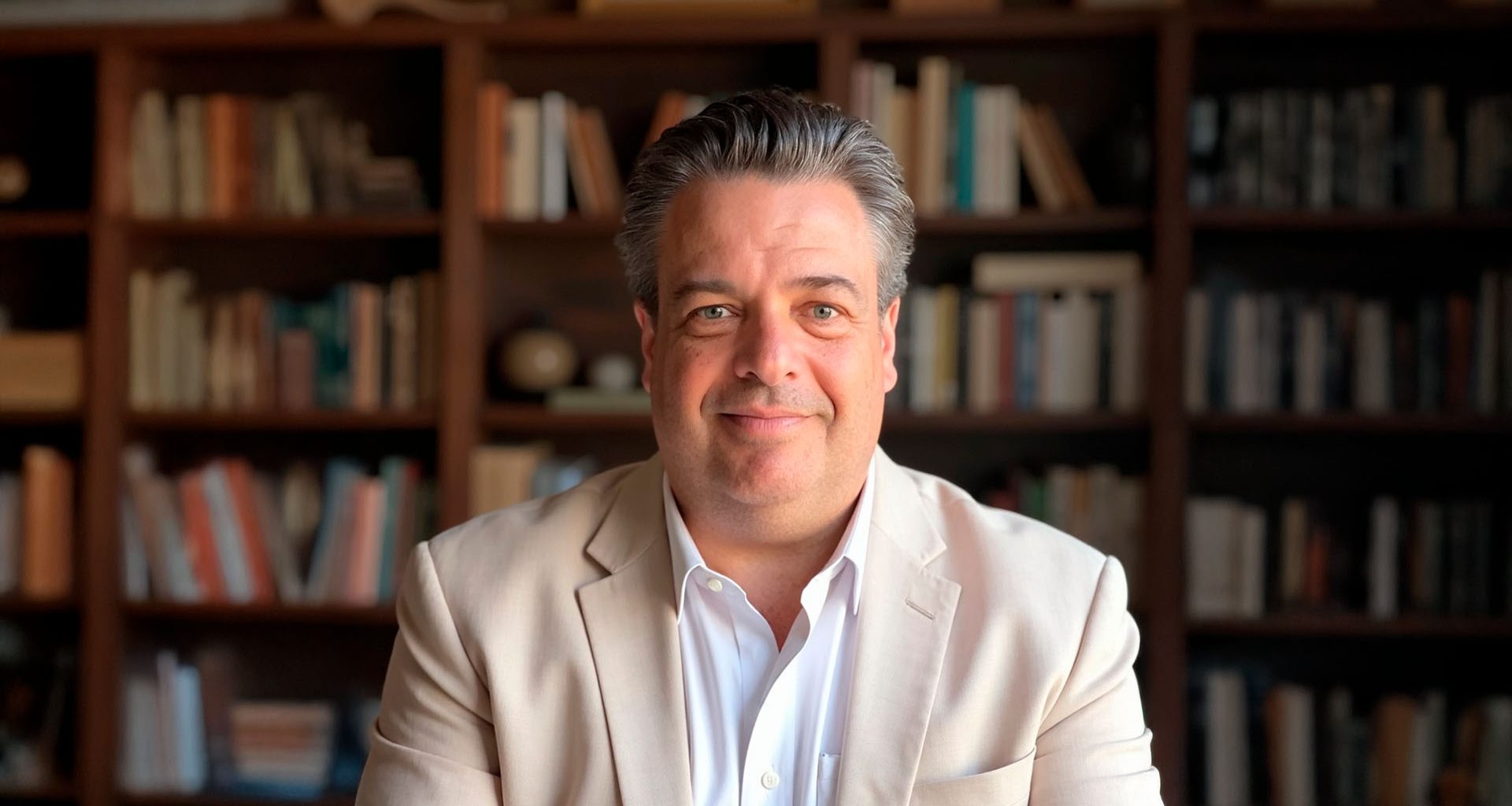
Ask a senior executive what they do, and you will almost certainly get a job title in return. It is the most efficient answer—and, increasingly, the most limiting. Adam Gronski argues that this title-first reflex quietly shrinks the leaders who rely on it. His case is not a wellness argument dressed up for LinkedIn. It is a claim about where leadership capability really comes from, and it cuts against a professional culture that rewards specialization above everything else—one that tells executives to pick a lane, own a niche, and let the lane do the talking.
Gronski’s own track record makes it a difficult argument to dismiss. Over a 20-plus-year career in media, he has operated at the highest levels of corporate revenue generation, notably founding PBS National Sales and generating over $500 million in corporate sponsorship support. Yet, while managing a substantial real estate portfolio through his boutique firm, River Crescent, alongside his media career, he has consistently resisted letting a single corporate designation define his horizon.
The Cost of Compression
The idea surfaced at a fundraising event for an organization where Gronski sits on the board. Everyone went around the table asking, “Oh, what do you do?” What struck him was not the question itself, but how readily he, and everyone else, answered it with a single line. “Isn’t that sort of an interesting thing? That’s how we usually describe ourselves: by what we do, even though we do a lot of different things.”
That compression has costs that few leaders take into account. Gronski’s own answer would have to include a legacy media career, a real estate portfolio, board service with the Chesapeake Conservancy, a growing art collection, backing an upcoming book, and a founding advisory seat at an organization called Heart of Matters. None of it fits on a business card.
“I have a job that gives me the ability to support my family, but I’m much more than that,” Gronski says. The professional habit of keeping work and personal life in separate boxes, he argues, is how “most play the game,” but we are not just one thing. Even on a LinkedIn profile, we usually reduce ourselves to a single title simply because encompassing everything we actually are — is incredibly difficult—but that difficulty is exactly where the truth of who we are, lives.”
Exploration as an Asset Class
The obvious objection is practical. Most leaders feel their day job leaves no room for anything else. Gronski’s response—backed by decades of driving half-a-billion dollars in corporate revenue—is that the room is not granted, it is taken. The taking is itself the point.
“I’m a big believer in stepping outside the boundaries of what your professional title says,” he says emphatically. “It’s the ultimate pivot to exploration. When you step outside your boundaries, you find your true passions. It gives you space and permission to develop and create new pathways for yourself.”
What makes the argument more than motivational is how these disparate pieces compound. Tylor House in Easton, Maryland, began as a standard multifamily property purchased through Gronski’s real estate company. But Gronski chose to redirect its purpose. “I wanted a space that housed all of my interests, which was my growing art collection, as well as a space that could be there for organizations that are near and dear to my heart.”
The result is a private contemporary art gallery that doubles as a civic engagement space, hosting community leaders and like-minded individuals. One asset, originally bought on strict commercial logic, now carries a portfolio of commitments at once. That is not a hobby bolted onto a career. It is capital allocation applied directly to a life, and it suggests the separation most professionals maintain between the two is a choice rather than a constraint.
The same instinct shows up in less conventional spaces. Gronski joined TikTok a couple of years ago simply to observe what people were looking for, and his conclusion was clear: community. He built one centered on meme curation, nostalgia, and personal inspirational messaging, assembling images from a shared Gen X childhood alongside the music and messages that defined it.
What began as a creative outlet has since blossomed into a massive digital footprint, drawing over 25,000 followers and nearly 1.5 million likes. When asked how he intends to monetize a digital asset of that scale, Gronski notes that the return on investment right now is strictly “societal”. He is focused on the raw equity of human connection, though he hasn’t ruled out how he might leverage and monetize that reach in the future.
“It feeds into my core being, which is that we’re human-centric,” Gronski notes. “We all have these feelings and emotions, and it can be applied to everyone.” An executive learning in real-time how millions of people respond to emotional cues is running a live feedback loop on human connection—one that most traditional leadership programs cannot replicate.
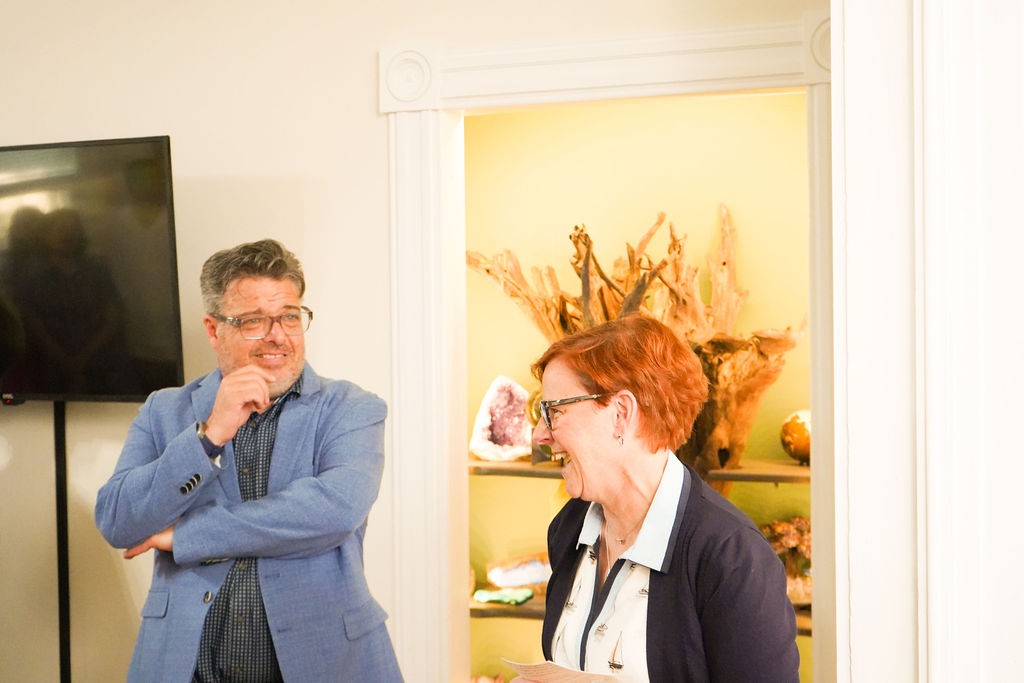
Adam Gronski with Susan Shingledecker, CEO of Chesapeake Conservancy at Tylor House event
Demystifying the “Renaissance” Label
Because of this expansive, cross-disciplinary portfolio, peers frequently try to pin a historic label on Gronski. One acquaintance recently observed, “You’re charting a different course… it’s like a Renaissance man model that people typically haven’t seen in generations.”
Gronski openly scoffs at the designation. “A Renaissance man?” he chuckles. “I can’t even spell ‘renaissance.'”
That self-deprecation isn’t just a clever deflection; it is an entry point into a much deeper part of his leadership philosophy: a radical commitment to a human-first approach rooted in raw honesty. For Gronski, being open about his own dyslexia is a vital part of breaking down standard corporate defenses. By posting openly about how his mind processes the world differently, he flips what legacy corporate systems label a “disability” into a unique blueprint for intuitive, spatial thinking and deep human empathy.
This deep interest in unfiltered, human-centric connection is exactly what drives his most recent partnerships. When he stepped into a founding advisory role at Heart of Matters, a platform launched in response to the profound global disruptions of October 7, it wasn’t a passive commitment. He joined forces directly with its founder, Francine McMahon—the formidable former publisher of The Hill and CEO of Capitol Image Counsel. Collaborating with a media heavyweight like McMahon highlights a core truth of the portfolio life: elite leadership is built on high-trust alliances that address societal urgency, moving far beyond standard corporate networking.
The same deliberate rejection of corporate posture shows up in his creative ventures. For The Way Life Works—a compilation drawn from interviews conducted throughout the career of New York Times bestselling author and PBS host Dennis Wholey—Gronski is explicitly listed as the Literary Patron.
It is a title intentionally revived from the Renaissance era but stripped of its historic pretension. After Wholey noted that traditional publishing routes could mean a corporate wait of at least two years, Gronski stepped into the patron role to bypass the legacy system entirely, backing the project so they could self-publish the book by the end of this year.
When asked if his extensive involvement means he is a co-author of the text, Gronski rejects the vanity metric outright. “I’m listed as the Literary Patron,” he says. “Sure, I could have bought my way onto the cover, but this is Dennis’ book.” He smiles, looking toward his own horizons. “At some point, I’ll have my own book. But the final chapters are still being written.”
The Incomplete Scoreboard
Gronski’s measurement language is where the argument gets its sharpest edge. He describes this operational shift as moving away from rigid corporate metrics and toward what he calls societal metrics: intentional time invested in family, and in the civic commitments that truly matter. For leaders trained to optimize strictly against quarterly scoreboards, this represents a genuine reallocation of energy, not a softening of focus. It assumes the traditional scoreboard is simply incomplete.
Ultimately, the goal is to stop letting a corporate title dictate the boundaries of a life. As Gronski puts it: “We are far more than the work we perform in our day jobs. The most important chapters we write usually happen when we clock out and let curiosity and connection take over.”
About the Author
Adam Gronski is a veteran media executive, founder of PBS National Sales, and managing partner of River Crescent real estate. Over a 20+ year career, he has generated more than $500 million in corporate sponsorship support while actively dedicating himself to civic engagement, a growing digital community of over 25,000 followers, and board service for the Chesapeake Conservancy. Follow Adam Gronski on LinkedIn for more insights on building a multifaceted professional portfolio, dyslexia-aware leadership, and leading beyond the job title.