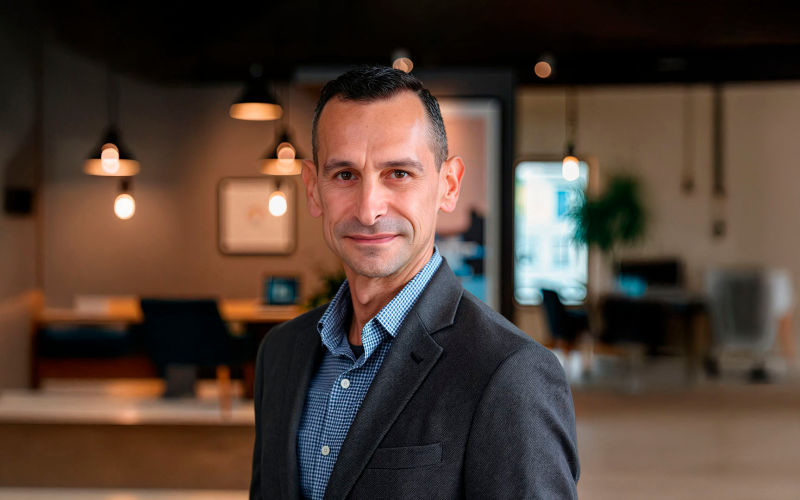


Every venture pitch deck now carries the word disruption somewhere on slide three, and the term has been drained of meaning through sheer overuse. That matters more than it sounds, because the money behind deep technology, or deep tech, has changed shape. Seed rounds that once funded a prototype now fund an entire engineering roadmap, which means founders can build far more before anyone tells them whether they built the right thing. Keith A. Blakely, who sits on the board of Sizzle, Inc., has spent a career on the hard side of that problem, moving inventions out of the laboratory and into commerce, and he draws a distinction most investors and operators skip past. Disruption that endures creates a foundation others build on. Everything else is a press release with a good extrapolation attached.
What Separates A Foundation From A Headline
Blakely’s definition is narrow on purpose. “Positive disruption creates a new foundation, whether it is a product, a process, a technology, or a paradigm, that future innovations and disruptions will build upon,” he says. New materials frequently qualify. They also frequently fail, and the failure mode is rarely scientific. “There are lots of laboratory creations that generate great press releases and extrapolations of possible impacts, but never achieve commercial success due to numerous factors, the inability to manufacture them affordably, consistently, or at scale.”
That last clause deserves more weight than it usually gets in a funding conversation. Affordability, consistency and scale are manufacturing problems, not discovery problems, and they sit downstream of the part that earns the coverage. An invention can be entirely real, fully validated in the lab, and still never reach a customer because nobody can make it twice the same way at a price anyone will pay. Founders who treat that gap as an execution detail, rather than the central risk, tend to discover it at the worst possible moment, typically after the capital that could have solved it has already been spent proving something that was never in doubt.
The Customer Is The Only Reliable Validator
Ask Blakely where value locks in along the path from invention to commercialization, and he points to a specific behavioral moment on the buyer’s side. “When the customer buys into the invention, begins to identify the critical elements to it becoming an item of true commerce and can identify the parameters that have to be met for its integration in some form, you’ve now established that a true value proposition exists.” Notice what he is describing. Not enthusiasm, not a letter of intent, but a customer doing engineering work on your behalf, and naming the specifications that would make integration possible. After that, he says, the remaining questions shift away from whether the thing works and toward how far it travels. “That is always a difficult projection to get right and a balance of both optimism and realism is a requirement for a successful business.”
This is where larger early rounds cut against founders rather than for them. “When a seed round can fund a full engineering roadmap, the danger is that you build the whole platform before the market tells you which part it wants,” Blakely says. His filter is blunt: you disrupt something for someone. At ART, he notes, the pitch was never advanced ceramics in the abstract. “GM built a thirty-million-dollar center in Saginaw because our whiskers solved a problem they already owned.” The operating rules follow from that. Let the customer set the spine of the roadmap. Make every milestone licensable or sellable on its own, because windows close, and Blakely has the scar to prove it – an initial public offering pulled the day before pricing in 2007. Include the incumbents rather than positioning against them, since “the strategic buyer you’d threaten is usually your best exit.” Bigger capital, in his reading, does not relax the discipline. It raises the cost of getting it wrong.
The Timeline Mistake That Kills Good Companies
The most expensive error Blakely sees is not technical. It is temporal. “Overestimating the near-term impact of an invention or disruption is one of the most common mistakes made by entrepreneurs who are anxious to achieve market validation, investor involvement, and financial success.” The mechanism is normally structural rather than emotional. Disruptions frequently land in the middle of a supply chain with several intermediate adopters who all have to say yes, and any one of them can delay the whole sequence. “The potential for any one of them to slow the process down is real and difficult to control or influence.” A founder can do everything right and still be held hostage by a customer’s customer.
The historical record supports him and is unkind to optimistic models. “It is a rule of thumb that new materials require at least a decade before finding real commercial application,” Blakely says, listing Teflon, carbon nanotubes, high-temperature superconductors, diamond-like carbon, and graphene as cases where ten years proved conservative. A company capitalized for three years of runway against a 12-year adoption curve does not fail because the science was wrong. It fails because the financing structure never matched the physics of the market. Blakely’s staged-milestone approach is the practical answer to that mismatch, converting a long arc into a series of independently fundable steps.
He applies the same logic to the space he considers most ripe right now, which is aging. Every developed country is getting older faster than its care system can grow, and loneliness now registers as a documented health risk on par with smoking. The enabling technology, multilingual conversational AI that remembers, listens and shows up daily, finally works. His guidance for leaders entering the category is unromantic. Get close to whoever pays, meaning families, senior-living operators, and payers, not only the end user. Build trust into the product, because the first well-publicized failure will set the entire category back. Structure for staged validation through pilots that prove outcomes rather than engagement, since that is what unlocks the next round once the field crowds.
Follow Keith A. Blakely on LinkedIn for more insights on deep tech commercialization, materials innovation, and building companies around genuine disruption.